
Autonomous Vehicle Simulation Platform
Duration
3 Years
3 Years
Tools
Figma, Miro, Unity, GitHub
Figma, Miro, Unity, GitHub
Team
1 Product Manager, 5–6 Engineers, 1 Designer (me)
1 Product Manager, 5–6 Engineers, 1 Designer (me)
Delivered:
34 new product features 15 UX/UI improvements ~230 new screens
Across a complex AI-driven cloud + offline product system for autonomous vehicle scenario creation and testing.
I was the sole product designer responsible for defining, designing, and scaling an AI-powered simulation platform used to create and test autonomous vehicle scenarios.
I led UX strategy for 1 primary user persona and 2 secondary use cases, maintaining and improving 4–5 critical user journeys across the product.
I was the sole product designer responsible for defining, designing, and scaling an AI-powered simulation platform used to create and test autonomous vehicle scenarios.
I led UX strategy for 1 primary user persona and 2 secondary use cases, maintaining and improving 4–5 critical user journeys across the product.
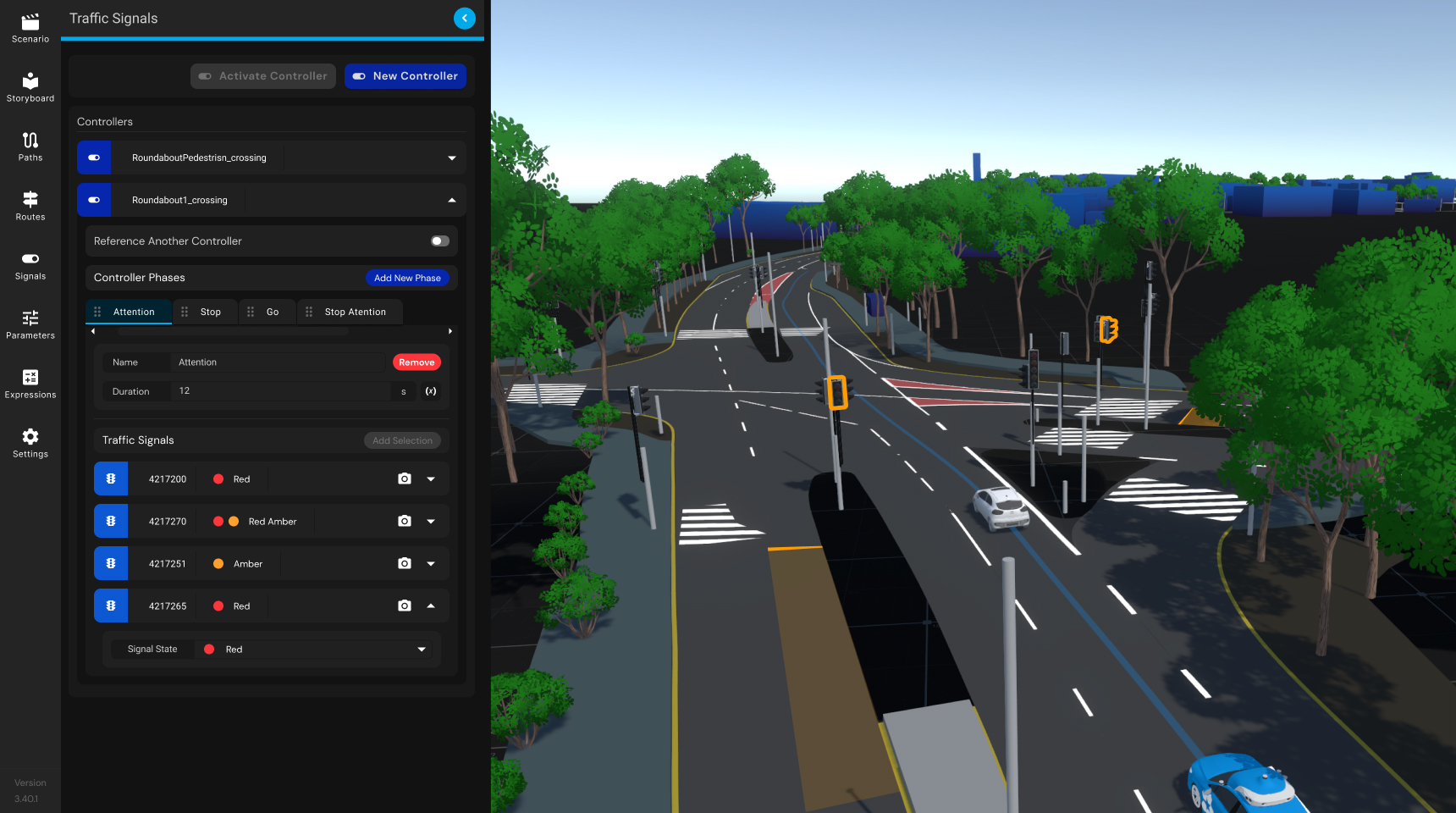
Highlighted Project — Traffic Signal Scenario Builder
Goal
Design a way to orchestrate complex traffic-signal behaviours on a map — including multi-lane vehicle interactions and pedestrian crossings — to build more realistic AV testing scenarios.Design Process
- Conducted user study sessions with in-house simulation experts to identify pain points in the existing workflow.
- Interviewed both expert and novice drivers to understand real-world safety expectations around traffic signals.
- Identified the need to visualise only relevant traffic lights and surface key relationships between controllers, lanes, and crossings.
- Studied and applied OpenSCENARIO traffic controller standards to ensure compatibility and interoperability with the AI simulation engine.
Impact
- ~x% increase in traffic-signal–based scenario creation.
- Reduced configuration errors and improved clarity in complex traffic intersections (qualitative feedback).
Product-wide Design System
Problem
The product had fragmented UI styles across several internal tools, causing inefficiencies and inconsistencies for both designers and engineers.My Responsibilities
- Created a dedicated Git branch and reviewed CSS style files directly from code, rebuilding components in Figma with 1:1 naming and structure.
- Led collaboration across a design team of four (timeline, map, routes, vehicle traffic lights, menus, app bars) to unify interaction patterns and visual language.
- Maintained design documentation for accessibility and clarity across front-end engineering and design teams
Impact
- More than 50% reduction in UI creation time for new screens or updates.
- More consistent design experience, increasing product trust and usage (qualitative feedback).
- Enabled rapid variant changes during reviews and user testing sessions, improving collaboration and iteration speed.
Summary
Across the product, I brought structure, clarity, and scale to an AI-driven simulation platform used for autonomous vehicle testing. My work spanned complex systems design, UX research, multi-team alignment, and delivering measurable improvements in efficiency, usability, and design-engineering alignment.